How to Choose Your Bike Size
How to Choose Your Bike Size? A Complete Guide to Finding the Perfect Size
Choosing the right bike size is essential for your comfort and performance. The right bike size is necessary to maintain a certain level of comfort, performance and safety. On the other hand, a badly fitted bike can cause pain, premature fatigue and even injury.
This guide explains how to work out precisely which bike size matches your build, whether you are looking for a road bike, an MTB or a city bike. We help you calculate the bike size that suits you using a simple method and size charts.
Why is bike size so important?
Riding a bike of the right size greatly improves your cycling experience. The right size lets you pedal efficiently, hold a correct posture and fully enjoy your rides without discomfort. A frame that is too big will force you to stretch excessively, while a frame that is too small will cramp you and limit your range of movement. In both cases, you risk pain in your back, knees or shoulders.
How do you choose the right size for your bike?
Step 1: Calculate your inseam height: the key measurement for knowing your bike size
To begin with, you need to measure your inseam. The inseam measurement is the most reliable reference for choosing your bike. Here is how to go about it: For this measurement, we advise you to take off your shoes and get someone to help you in order to reduce measurement errors.
-
Stand against a wall, take the most upright position possible and look straight ahead. Your legs should be slightly apart, by about 20 cm.
-
We advise you to place a spirit level or a book between your legs, pressing up lightly, to recreate the pressure of the saddle.
-
Now take the measurement from the floor up to the top of the level or the book. It is important that the tape measure is parallel to the wall while you measure.
Once you have taken this measurement, apply the following formula depending on how you ride:
• Your road bike size = Inseam X 0.65 • Your MTB size = Inseam X 0.56
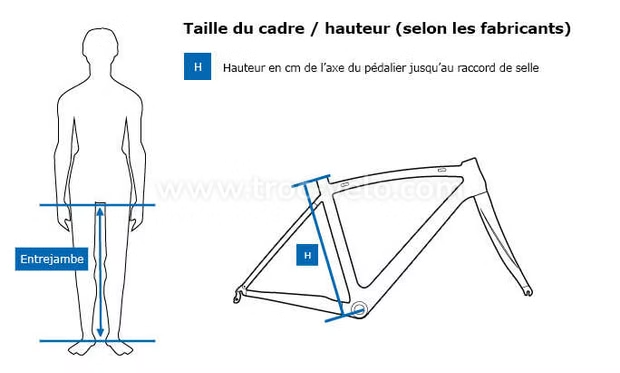
Step 2: Work out the matching frame size in centimetres
Your overall height remains a useful indicator, particularly for a first estimate. Manufacturers generally provide size charts based on the rider's height. Once you have taken this measurement, use our conversion chart to get your bike size for the way you ride:
Road bike
For a road bike, the size is generally measured in centimetres and corresponds to the length of the seat tube:
| Size | Frame (cm) | Rider height (cm) | Inseam (cm) |
|---|---|---|---|
| XS | 47-50 | 155-165 | 71-77 |
| S | 51-53 | 163-170 | 76-79 |
| M | 54-56 | 170-178 | 79-83 |
| L | 57-59 | 178-185 | 83-87 |
| XL | 60-63 | 185-195 | 87-93 |
MTB (Mountain Bike)
MTBs often use sizes in inches or letters:
Size chart - Kids' Bikes
| Height (cm) | Approximate age | Wheel size (inches) |
|---|---|---|
| 85-100 | 2-3 years | 12" |
| 100-115 | 3-5 years | 14" |
| 115-125 | 5-6 years | 16" |
| 125-135 | 6-8 years | 18" |
| 135-145 | 8-9 years | 20" |
| 145-160 | 9-11 years | 24" |
Size chart - Adult Bikes
| Rider height (cm) | Matching frame (cm) | Wheel size |
|---|---|---|
| 160-170 | 48-52 | 26" / 27.5" / 29" |
| 170-180 | 52-56 | 27.5" / 29" |
| 180-190 | 56-60 | 27.5" / 29" |
| 190 and over | 60 and over | 29" |
City bike and e-bike
These bikes generally use a simplified system:
| Size | Rider height (cm) |
|---|---|
| S | Under 165 |
| M | 165-175 |
| L | 175-185 |
| XL | Over 185 |
Essential adjustments and extra tips
Even with the right frame size, some adjustments are still needed to optimise your position.
Saddle height
Adjust the saddle height so that your leg is almost straight (a slight bend of 25-30 degrees) when the pedal is at its lowest point. A saddle that is too low tires your knees, while a saddle that is too high prevents smooth pedalling.
Handlebar position
The distance and height of the handlebar affect your comfort and aerodynamics. For leisure riding, favour an upright position. For performance, opt for a lower, more stretched-out position.
Stem length
If you feel discomfort despite having the right frame size, changing the stem length can correct your position without changing bike.
Differences between bike brands
Be careful, sizes vary between manufacturers. An M frame from one brand can be equivalent to an L from another. Always check the size chart specific to the brand you are thinking of buying from. Some brands also offer women-specific geometries, with frame tubes adapted to female proportions, generally characterised by a shorter torso and proportionally longer legs.
Try before you buy
Nothing replaces a real test ride. If possible, test the bike over a few kilometres to assess your comfort. During the test, check that you can easily put your foot on the ground when stopped, that your arms are slightly bent while holding the handlebar, and that you feel no unusual tension.
Always put safety first and make sure the child can easily touch the ground with their feet.
What should you do if you are between two sizes?
This situation happens often. Here is how to decide: If you are looking for comfort and ride mainly on the road or in town, opt for the smaller size, which will offer more manoeuvrability. If you are aiming for performance and ride long distances, favour the larger size, which will allow a more stretched-out, aerodynamic position. For MTB, generally choose the smaller size, which will offer more control and responsiveness on technical trails.
Common mistakes to avoid
Do not rely solely on your old bike size, especially if you are changing type or brand. Never buy a bike online only without checking the exact measurements. Avoid underestimating the importance of adjustments after purchase. Some cyclists think that a bigger bike will make them look sportier, but it only harms their comfort and performance.
Why is it hard to know which bike size suits me?
Warning: bike sizes depend on manufacturers and brands! Each manufacturer has its own way of measuring the size of its bikes: there is no standard.
A size M bike from one manufacturer will not necessarily match a size M bike from another manufacturer.
Historically, bike frames had a straight top tube: so the bike size was worked out from the length of the seat tube.
Over time, this has become less and less valid for calculating bike size, notably with the appearance of new frame geometries such as:
- The sloping frame (angled top tube)
- The full-suspension frame
- The city bike frame
- etc.
Most European manufacturers have moved to international sizes such as S, M, L, XL. Others continue to use "classic" sizes by measuring the length of the seat tube.
Conclusion
As you can see, many parameters come into play when buying a bike that fits you. Choosing the right bike size requires taking into account your build, how you ride and your goals. Measure your inseam precisely, check the brand-specific charts, and do not hesitate to try several sizes before making up your mind. We also advise you to meet your seller and try the bike. Indeed, there is nothing like it to confirm your choice and check whether the bike suits your build and your expectations.
A well-fitted bike turns every ride into a pleasure. Take the time to make the right choice, and your body will thank you in the long run.
See the posture assessment listings
See the second-hand road bike listings
See the second-hand MTB listings
See the second-hand kids' bike listings
See the latest listings
See the Troc Vélo blog
See the frequently asked questions on Troc Vélo
Discover our Bike Forum
Find us on the Google Play Store and the Apple Store

|

|